
Applying custom attributes to class members in C# is a powerful way to add metadata about those members at compile time.
PostSharp provides the ability to create a custom attribute class that, when applied to another class, can iterate through those class members and automatically decorate them with custom attributes. This can be useful, for example, to automatically apply custom attributes or groups of custom attributes when new class members are added, without having to remember to do it manually each time.
Introducing new custom attributes
In the following example, we create an attribute decorator class that applies the .NET DataContractAttribute to a class and DataMemberAttribute to members of a class at build time.
Start by creating a class called
AutoDataContractAttributethat derives from TypeLevelAspect. TypeLevelAspect transforms the class into an attribute that can be applied to other classes. Also implement IAspectProvider, which exposes the ProvideAspects(object) method for iterating on class members. ProvideAspects(object) will be called once for each class to which the aspect is applied and will contain the code for applying the attributes:public sealed class AutoDataContractAttribute : TypeLevelAspect, IAspectProvider { public IEnumerable<AspectInstance> ProvideAspects(object targetElement) { } }Implement the ProvideAspects(object) method to cast the
targetElementparameter to aTypeobject. Note that this method will be called at build time. TheTypeobject can be used for inspecting each member and making decisions about when and how to apply custom attributes. In the following snippet, the implementation returns a new AspectInstance for theTypecontaining a new DataContractAttribute and then iterates through each property of theTypereturning a new AspectInstance with the DataMemberAttribute for each. Note that the DataContractAttribute and DataMemberAttribute are both wrapped in CustomAttributeIntroductionAspect objects:public sealed class AutoDataContractAttribute : TypeLevelAspect, IAspectProvider { // This method is called at build time and should just provide other aspects. public IEnumerable<AspectInstance> ProvideAspects(object targetElement) { Type targetType = (Type) targetElement; CustomAttributeIntroductionAspect introduceDataContractAspect = new CustomAttributeIntroductionAspect( new ObjectConstruction(typeof (DataContractAttribute).GetConstructor(Type.EmptyTypes))); CustomAttributeIntroductionAspect introduceDataMemberAspect = new CustomAttributeIntroductionAspect( new ObjectConstruction(typeof (DataMemberAttribute).GetConstructor(Type.EmptyTypes))); // Add the DataContract attribute to the type. yield return new AspectInstance(targetType, introduceDataContractAspect); // Add a DataMember attribute to every relevant property. foreach (PropertyInfo property in targetType.GetProperties(BindingFlags.Public | BindingFlags.DeclaredOnly | BindingFlags.Instance)) { if (property.CanWrite) yield return new AspectInstance(property, introduceDataMemberAspect); } } }Note
Since the
ProvideAspectsmethod returns anIEnumerable, use theyieldkeyword to return aspects for PostSharp to apply.Apply the
AutoDataContractAttributeclass. In the following example, we apply it to aProductclass where it will decorateProductwith DataContractAttribute and each member with DataMemberAttribute:[AutoDataContractAttribute] public class Product { public int ID { get; set; } public string Name { get; set; } public int RevisionNumber { get; set; } }
Copying existing custom attributes
Another way to introduce attributes to class members is to copy them from another class. This is useful, for example, when distinct classes have members with the same names and the same types. In this case, attributes can be defined in one class and then that class can be used to decorate other similar classes with the same attributes.
In the following snippet, the Id and Name properties of Product have both been modified to contain attributes from the System.ComponentModel.DataAnnotations namespace: Editable and Required on Id, and Display and Required on Name. Below Product is another class called ProductViewModel containing the same properties to which we want to copy the attributes:
class Product
{
    [EditableAttribute(false)]
    [Required]
    public int Id { get; set; }

    [Display(Name = "The product's name")]
    [Required]
    public string Name { get; set; }
    public int RevisionNumber { get; set; }
}

class ProductViewModel
{
    public int Id { get; set; }
    public string Name { get; set; }
    public int RevisionNumber { get; set; }
}
To copy the attributes from the properties of Product to the corresponding properties of ProductViewModel, create an attribute class which can be applied to ProductViewModel to perform this copy process:
Create a TypeLevelAspect that implements IAspectProvider. In the following snippet, the class is called
CopyCustomAttributesFrom:class CopyCustomAttributesFrom : TypeLevelAspect, IAspectProvider { }Create a constructor that takes the class type from which the property attributes are to be copied. This class type will be used in the next step to enumerate its properties:
class CopyCustomAttributesFrom : TypeLevelAspect, IAspectProvider
{
private Type sourceType;

public CopyCustomAttributesFrom(Type srcType)
{
    sourceType = srcType;
}
	}
Implement ProvideAspects(object):
class CopyCustomAttributesFrom : TypeLevelAspect, IAspectProvider
{
	// Details skipped.

	public IEnumerable<AspectInstance> ProvideAspects(object targetElement)
	{
	    Type targetClassType = (Type)targetElement;

	    //loop thru each property in target
	    foreach (PropertyInfo targetPropertyInfo in targetClassType.GetProperties())
	    {
	        PropertyInfo sourcePropertyInfo = sourceType.GetProperty(targetPropertyInfo.Name);

	        //loop thru all custom attributes for the source property and copy to the target property
	        foreach (CustomAttributeData customAttributeData in sourcePropertyInfo.GetCustomAttributesData())
	        {
	            //filter out attributes that aren't DataAnnotations
	            if (customAttributeData.AttributeType.Namespace.Equals("System.ComponentModel.DataAnnotations"))
	            {
	                CustomAttributeIntroductionAspect customAttributeIntroductionAspect =
	                    new CustomAttributeIntroductionAspect(new ObjectConstruction(customAttributeData));

	                yield return new AspectInstance(targetPropertyInfo, customAttributeIntroductionAspect);
	            }
	        }

	    }
	}
}
The ProvideAspects(object) method iterates through each property of the target class and then gets the corresponding property from the source class. It then iterates through all custom attributes defined for the source property, copying each to the corresponding property of the target class. ProvideAspects(object) also filters out attributes that are not from the
System.ComponentModel.DataAnnotationsnamespace to demonstrate how you may want to ignore some attributes during the copy process.Decorate the
ProductViewModelclass with theCopyCustomAttributesFromattribute, specifyingProductas the source type in the constructor. During compilation, the ProvideAspects(object) method ofCopyCustomAttributesFromwill then perform the copy process fromProducttoProductViewModel:[CopyCustomAttributesFrom(typeof(Product))] class ProductViewModel { // Details skipped. }
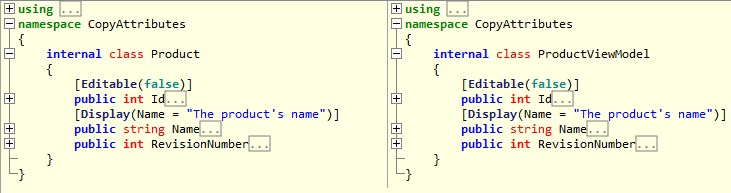
The following screenshot shows the Product and ProductViewModel classes reflected from an assembly. Here we can see that the Editable and Display attributes were copied from Product to ProductViewModel by the CopyCustomAttributesFrom aspect at build time:
Note
It is not possible to delete or replace an existing custom attribute.
See Also
Reference
ProvideAspects(object)
CopyCustomAttributesAttribute
DataContractAttribute
DataMemberAttribute
TypeLevelAspect
IAspectProvider
AspectInstance
CustomAttributeIntroductionAspect